
Thread-cutting tapping screws
Thread-cutting tapping screws cut the thread into the mating material. Tell us the thread size, point, and application, and we'll review everything before quoting.
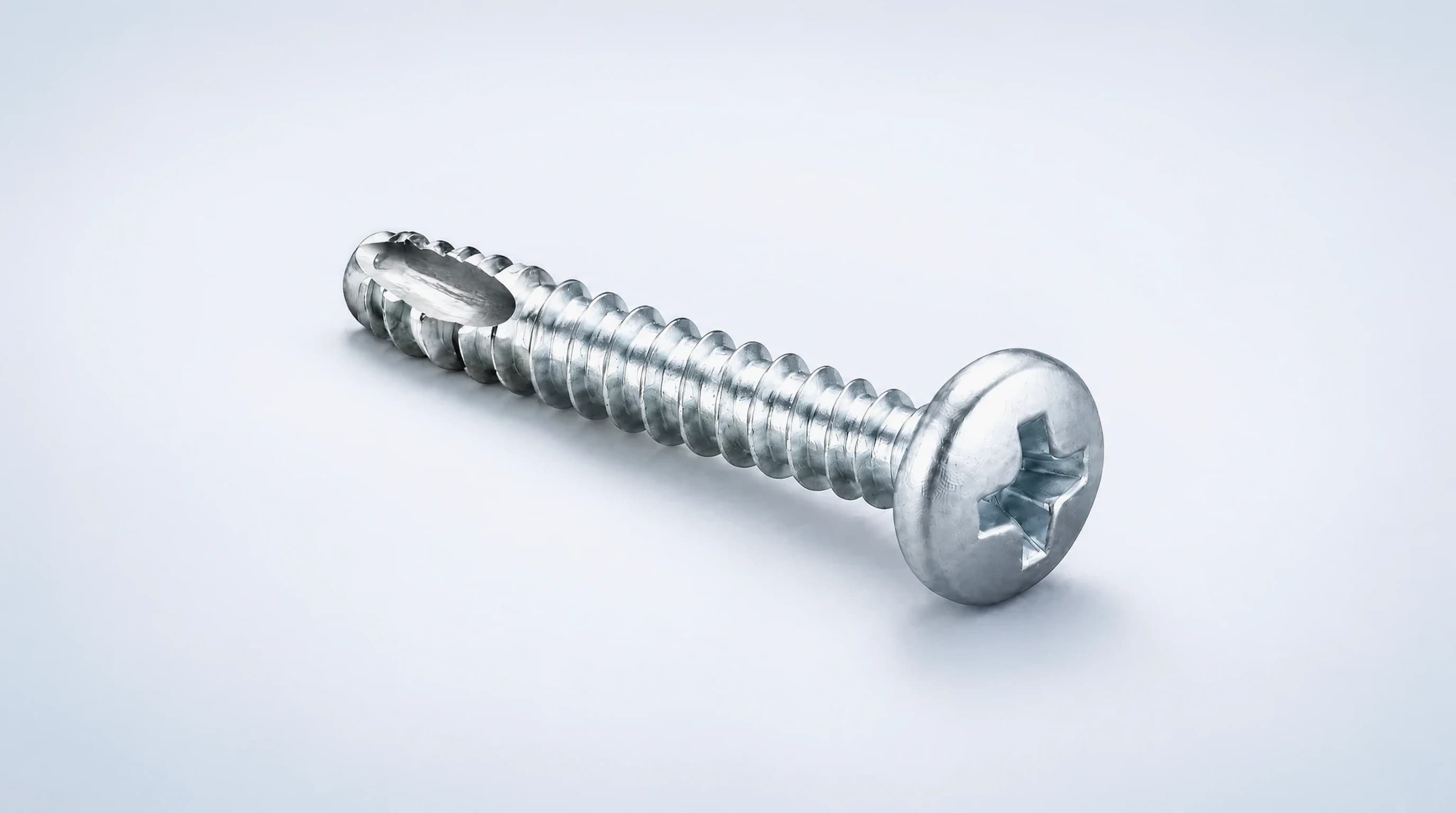
What it is and how it works
Tapping screws with cutting geometry at the point that helps create the thread in the mating material.
How it works
The slot or flute cuts material as the screw advances into a prepared hole. The point type affects how the screw starts and cuts the thread.
What sets it apart
The visible slot or flute distinguishes it from thread-forming tapping screws, which form the thread without that cutting geometry.
When it's typically considered
Considered when the requirement specifies a cutting point and a thread that must be created in the assembly.
Substrate and application
A prepared hole and a defined mating material. We review the specific application and chip formation with you.
KEY POINTS TO SPECIFY
Use these references to describe your part and fill in only what you already know.
The point references available to describe your part are Types D (or Type 1), 23, 25, and F. If your drawing calls for a different one, include it in your quote request.
What to send
Share the part number, drawing, or sample part, plus the dimensions, estimated quantity, and any known requirements. If something is still to be defined, note it in your request.
What helps us quote
Point type, thread, dimensions, mating material, head, drive, material, finish, and volume.
What each team can bring
Purchasing
Provide the part number, quantity, material, finish, and any cleaning or process requirements.
Engineering
Specify the thread designation, point type, material, and the hole in your application, if they're defined.
Quality
Include requirements for chip formation, cleaning, installation, or testing when they're relevant to your product.
Key points to specify
Thread, profile, and point
Thread size
Point type
 Type 25 point
 Type D (Type 1) point
 Type 23 point
 Type F point
View head and drive references
These references help describe your part. The full list is available in the quote request.
Head styles
 Flat head 100°
 Flat head 82°
 Flat undercut head
 Flat top head
 Binding head
 Binding undercut head
 Button head
 Cheese head
 Fillister head
 Fillister head (cap screw)
 Indented hex washer head
 Indented hex head
 Indented hex flange washer head
 Oval head
 Oval undercut head
 Pan head
 Pan washer head
 Round head
 Round washer head
 Truss head
 Truss washer head
 Low-profile truss head
 Wafer head
Drive types
 Torx-style 6-lobe drive
 Security Torx-style 6-lobe (tamper-resistant)
 Slotted
 Square drive
 Combination drive (square + Phillips)
 Combination drive (square + Phillips + slotted)
 Combination drive (Phillips + slotted)
 Combination drive (square + slotted)
 Phillips
 Pozidriv (Type IA)
 Allen-style hex socket drive
 Security Allen-style hex socket (tamper-resistant)
Under-head features
 Full serrations
 Nibs under head
 Shoulder
Material and finish
Enter the material, grade, and finish, or attach the specification. If you don't know them yet, you can leave them open.
Materials
Finishes
Fill in what you already know.
You don't need to fill in everything now. Your selections carry over when you continue.
If yours isn't listed, choose "Other specification."
Most common lengths. If yours isn't listed, choose "Other specification."
Measured under the head, except for flat countersunk heads (overall length) and oval heads (from the edge of the countersink). If your drawing uses a different reference, note it under additional requirements.
Point
Head
Drive
You can continue with this family and fill in the rest later.
Continue your requestSend us your requirements. We'll review them and follow up.
You can start with a drawing, a specification, a sample part, a part number, or a description.